
Conversion to Buddhism
A Path of Reason, Morality, and Equality
Why Buddhism? – Philosophical Background
Dr. B.R. Ambedkar turned to Buddhism because he found in it a philosophy rooted in rational thought, ethical living, and human dignity. Unlike religions that justified caste, inequality, or blind faith, Buddhism offered a moral framework based on compassion, liberation from suffering, and the pursuit of wisdom. Ambedkar saw the Buddha’s teachings as a scientific approach to understanding life—free from rituals, superstition, and social hierarchy. For him, Buddhism represented a way to rebuild society on the principles of justice, equality, and self-respect.
Ambedkar believed that Buddhism aligned perfectly with the values embedded in the Indian Constitution: liberty, equality, and fraternity. He viewed the Buddha not just as a religious figure, but as a revolutionary thinker who challenged oppression and promoted social harmony. By embracing Buddhism, Ambedkar offered millions of marginalized people a spiritual path that restored their dignity and empowered them to rise above centuries of discrimination.
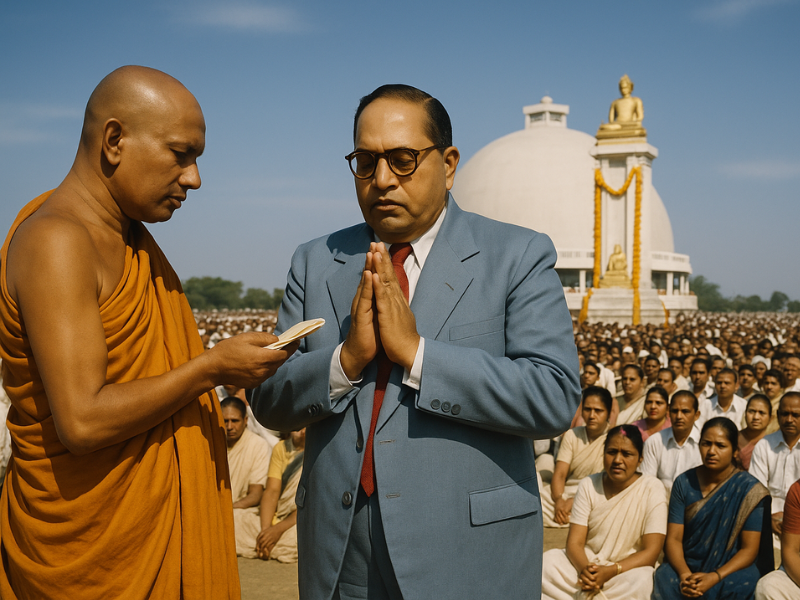
A Historic Mass Conversion to Buddhism – 500,000 Followers
Deeksha Ceremony at Nagpur (1956)
On 14 October 1956, Dr. B.R. Ambedkar embraced Buddhism in a historic ceremony held at Nagpur’s Deekshabhoomi. This moment marked the beginning of a new spiritual and social movement in India. Ambedkar took the Three Refuges and Five Precepts from Mahasthavir Chandramani and formally adopted Navayana Buddhism—his reinterpretation of Buddhist philosophy rooted in equality, rationality, and social justice.
More than 500,000 followers took deeksha alongside him, making it one of the largest mass religious conversions in modern history. For millions of Scheduled Castes and oppressed communities, this act was not just a change of faith but a declaration of human dignity and liberation from caste oppression. The Nagpur ceremony became a turning point, inspiring a nationwide Buddhist revival and symbolizing Ambedkar’s lifelong mission to create a society based on liberty, equality, and fraternity.
Core Principles of Navayana
Teachings of Navayana Buddhism
Navayana Buddhism, as envisioned by Dr. Ambedkar, emphasizes equality, rationality, social ethics, and human dignity over ritual and tradition.
Primacy
of Reason
Encourages critical thinking and rejects superstition, empty rituals, blind faith, promoting clarity.
Social
Equality
Declares all humans equal and opposes caste discrimination, inherited hierarchy, promoting justice.
Compassionate
Morality
Promotes ethical living grounded in kindness, fairness, justice, and responsibility toward others.
Liberation
Through Action
Focuses on social change through collective progress, purposeful action, dignity, and upliftment.
From India to the World
Global Spread of Ambedkarite Buddhism
Since Dr. B.R. Ambedkar’s historic conversion at Nagpur in 1956, Ambedkarite Buddhism has grown beyond India. Inspired by his message of equality, rationality, and social justice, communities across the United States, United Kingdom, Canada, Japan, and Southeast Asia have embraced Navayana Buddhism. International centers, study groups, and cultural organizations continue spreading Ambedkar’s modern interpretation of Buddhism, rooted in social reform and human dignity.
The global movement emphasizes universal values: compassion, equality, and liberation from oppression. Ambedkarite Buddhists participate in dialogues on peace, anti-caste activism, and social transformation worldwide. Through publications, digital platforms, and community initiatives, Navayana Buddhism has established a strong international presence, reflecting Ambedkar’s vision of an equal, enlightened, and socially just society.